Homeowners usually ask this as a maintenance question — "I'm tired of re-mulching every year, should I just do rock?" — and that's a fair reason to ask. But the answer depends less on what you want to maintain and more on what's planted in the bed and where the bed sits.
Here's how we decide.
What mulch actually does
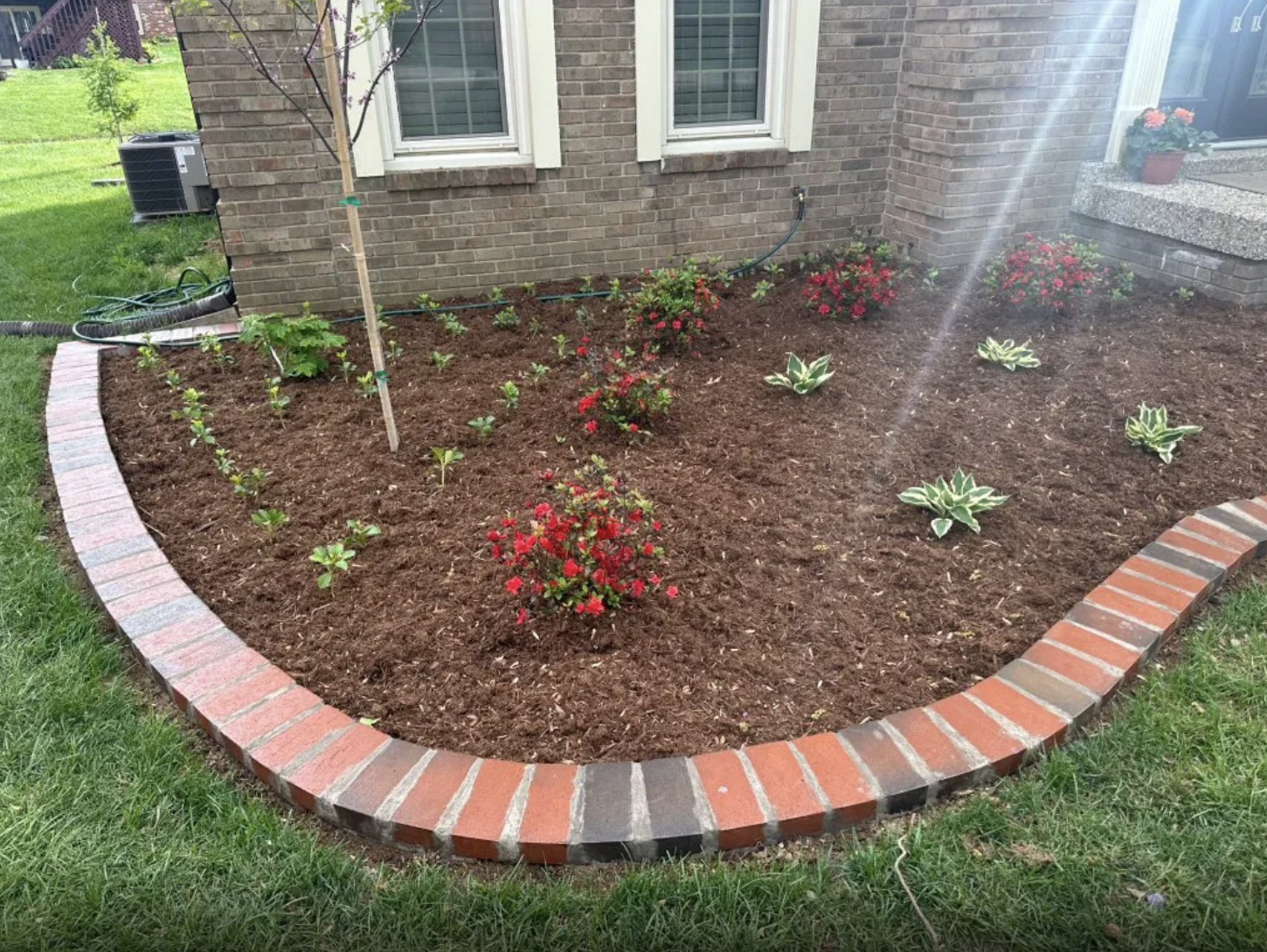
Mulch is not just a brown surface. As hardwood mulch breaks down it adds organic matter to the soil, which matters a lot on Louisville's clay. It moderates soil temperature, holds moisture through summer, suppresses weeds, and keeps a clean line between bed and lawn.
The trade-off is that it breaks down — that's the whole point — so it needs topping off, usually once a year. It can also fade in full sun and wash out of beds on a slope during heavy rain.
Mulch is the right call for: planted beds with perennials, shrubs, and young trees; anything you plan to change or add to; foundation beds; and any bed where you're trying to improve poor soil.
What river rock actually does
Stone doesn't decompose. Put it down over quality landscape fabric and it stays put for years with only occasional cleaning and the odd top-up. It won't wash away in a downpour, which makes it excellent in drainage swales, under downspouts, and on slopes. It reads clean and modern, and it doesn't hold moisture against a foundation.
The trade-offs are real, though. Rock absorbs heat and radiates it — a stone bed in full south-facing sun runs meaningfully hotter than a mulched one, which stresses plants that aren't chosen for it. It contributes nothing to your soil. Weed seed still blows in and germinates in the dust that collects between stones, and weeding gravel is genuinely worse than weeding mulch. And when leaves fall into it, they're a nuisance to clear. Removing rock later is a real job, not an afternoon.
Rock is the right call for: drainage paths and downspout outlets; narrow strips along a driveway or foundation; slopes where mulch washes; low-plant or no-plant beds; and modern designs where the look is the point.
The mistake we see most
Rock installed over sun-loving-only design assumptions, around plants that wanted cool, moist, organic soil. Two years later the shrubs are struggling, the bed is full of weeds growing in the silt between stones, and it costs more to remove the rock than it did to install it.
The second most common: landscape fabric under mulch. It stops mulch from doing its job — feeding the soil — and eventually weeds root on top of it anyway. We use fabric under stone, not under mulch.
What we usually recommend in Louisville
Most properties end up mixed, and that's the right answer. Mulch in the planted beds where soil health matters. River rock where water moves, where access is tight, or where nothing is planted. That combination looks intentional and cuts long-term maintenance without hurting the plants.
We did exactly this on a recent job: a bare, weedy strip between arborvitae became a clean river rock bed with new plantings and lighting, while the foundation beds nearby got a full clean-up and fresh mulch. Both are in our project gallery as before-and-afters.
Either way, install it properly
Whichever you choose, the same rules apply: pull the existing weeds rather than burying them, cut a clean spade edge so the material stays in the bed, keep depth at two to three inches for mulch and about two for stone, and never let either one pile against a trunk or a foundation.
If you want a hand deciding bed by bed, that's part of what we do on every softscaping walkthrough — get in touch and we'll take a look.
Planning a landscape project in Louisville?
Tell us what you're thinking and we'll walk the property, talk through options, and send a written estimate.
Get a free estimate